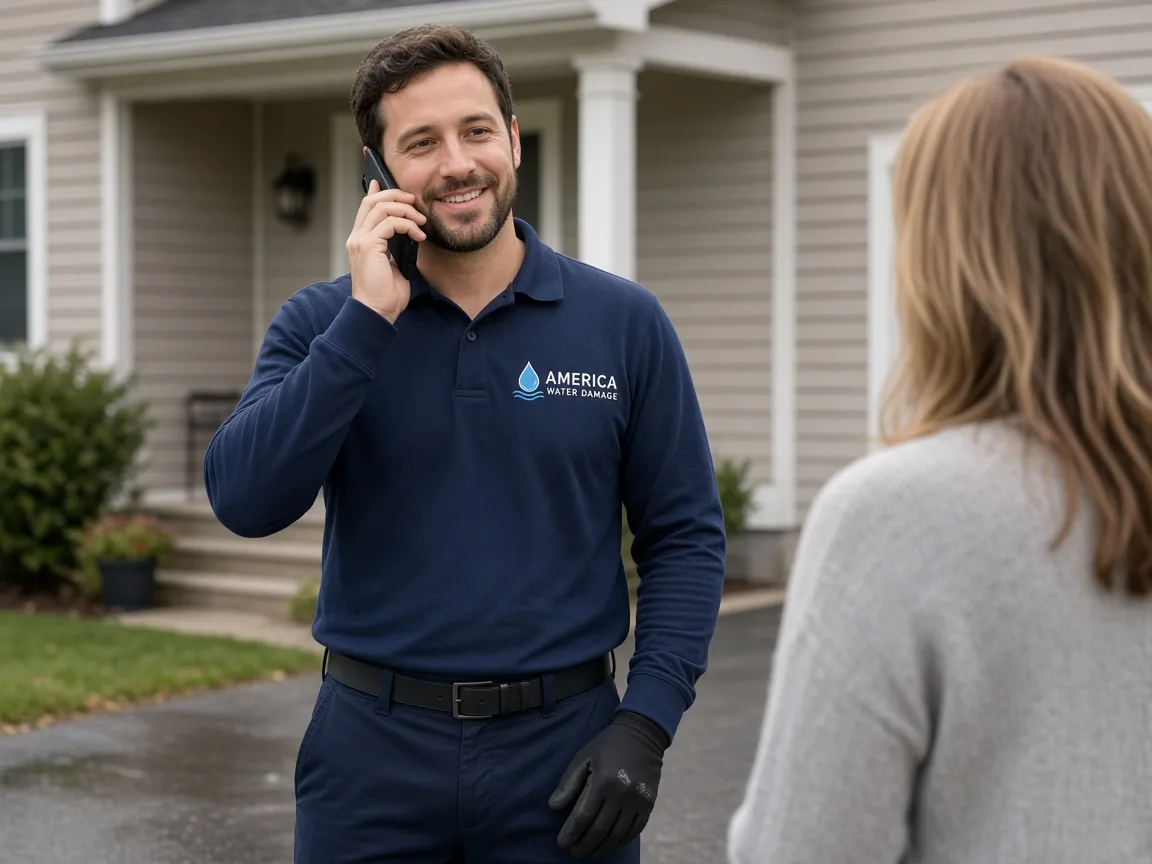
Ground-floor commercial premises take flood water first and take it worst. The fit-out is at floor level, the stock is on the lowest shelves, and the point-of-sale equipment sits where the water arrives. Commercial flood damage is not one loss but three running at once, because stock, fixtures and the fit-out sit on different parts of the policy, and the salvage decision on the first of them cannot wait for the paperwork on the other two.
Why choose this network: what it actually does for you
Very few restoration firms hold a dedicated commercial flood page, and the ones that do tend to describe pumping capacity. Capacity is rarely the constraint. The constraint is triage.
Flood water arriving across the ground is treated as grossly contaminated from the outset, which means the question for every item is not how do we clean this but can this lawfully and safely be kept at all. For a trading business that question has to be answered within hours, item class by item class, while a loss adjuster has not yet attended and while the premises are closed and losing revenue every day.
Our part is to take the details, where the premises are in Five Points, CA, how deep the water got, what it reached and what sector the business is in, then connect you with an independent local contractor who handles commercial flood work. The restoration and the salvage judgements belong to that contractor.
Because America Water Damage operates no crews and sells no restoration, there is no scope we gain from. The triage sequence below is written to get you trading again and to keep your claim defensible, which are not always the same objective a contractor is optimising for.
Why this can't wait: the clock, not the calendar, decides your outcome
A commercial flood runs three clocks, and they expire in a deliberate order.
The first is contamination. Grossly contaminated water does not become less contaminated while it waits. Porous goods and absorbent fit-out that have taken it up generally cannot be made safe, and the longer they sit the further contamination wicks into materials that were initially above the line.
The second is salvage. Some categories are recoverable if dealt with immediately and unrecoverable a day later. Packaged goods with intact seals, sealed electronics, hard fixtures and metal shelving often survive. Soft goods, open stock, anything absorbent and anything intended for consumption rarely do. The distinction is time-sensitive, which is why the salvage triage has to begin before the adjuster arrives rather than after.
The third is trading, and it is usually the biggest number. Every day closed is turnover lost, staff unproductive and fixed costs still running, and that figure normally exceeds the restoration invoice. It also drives the claim: business interruption cover turns on the length of the closure and on evidence of what was done to shorten it.
Those clocks argue for the same thing. Document everything first, then remove what cannot be kept, then dry what can, and record each step as you go. Waiting for permission to start mitigating is the one decision that makes all three clocks worse.
Credentials to verify before anyone starts work
We hold no licences, no certifications and no insurance covering restoration, because we perform none of it. What follows is what a qualified contractor in Five Points, CA should be able to produce on request for commercial flood work.
Ask for the licence or registration that applies to commercial work where the premises sit, and verify it with the issuing body. Ask separately about mould credentials, which several jurisdictions license apart from construction.
Ask for proof of general liability cover at a limit suited to the premises, and workers compensation cover. Ask for IICRC certification for the relevant standard and, specifically, what their written protocol is for grossly contaminated water, because that is the category a flood puts you in.
Then ask for three things. A written scope issued before anything is removed, naming item classes and giving reasons. An itemised salvage and disposal record, photographed, because the adjuster will not see what has already gone. And a reporting format the carrier accepts, with daily readings and equipment logs assembled during the work rather than afterwards.
The situation: three insurance conversations in one flooded unit
Here is the situation this page exists for. A ground-floor retail unit floods overnight. In the morning there is stock on the floor, saturated shelving and display units, and a fit-out with absorbent wall linings and floor coverings. These are not one claim. Handle them as three.
Stock first, because it decays fastest and because it is the simplest to evidence. Photograph it in place before anything moves, then record it by line and quantity as it is triaged. Sealed and packaged goods may be recoverable, so segregate rather than discard wholesale. Anything for consumption that has contacted flood water goes, regardless of appearance, and in food-service premises that is not a commercial judgement but a regulatory one. Keep the disposal record, because an unevidenced write-off is the part of a claim most often reduced.
Fixtures and equipment second. Metal shelving, hard counters and sealed display units often clean and survive. Anything with an absorbent core, chipboard carcassing in particular, usually does not: it swells, loses strength and cannot be sanitised through its thickness. Powered equipment that was submerged should be isolated and assessed rather than tested, because switching it on can destroy both the equipment and the evidence.
Fit-out third, and this is the structural conversation. Floor coverings, wall linings, insulation and partition bases that took contaminated water generally come out to a line above the visible level, so the cavity behind can be cleaned and dried. This is the part tenants most often try to shortcut by cleaning and sealing over, and it is the part that produces the complaint six weeks later.
Then the fourth conversation that is not about property at all. Your trading loss sits under business interruption cover, and it is evidenced separately: the trading baseline, the closure period and what you did to shorten it. Start that record on day one.
Tell us what the premises are, how deep it got and what sector you are in, and we will connect you with an independent local contractor who can triage it and scope it in writing.
The cover, triage and protocols behind a commercial flood job
A commercial flood is decided by which policy responds, what can be kept and how the fabric is dried under contamination rules. These are the terms that decide those.
Commercial flood cover and NFIP commercial policies
Flood cover for commercial premises is generally a separate purchase from the ordinary property policy, and policies written through the National Flood Insurance Program for non-residential risks have their own structure: building and contents are covered separately, limits are set per policy rather than per loss, and below-grade areas are treated restrictively. Crucially, NFIP cover does not include business interruption, so a flooded trading business with flood cover alone may be reimbursed for the premises and the stock and recover nothing for the closure. Waiting periods also apply, so cover cannot be arranged against a forecast. Ask your broker which elements you actually hold, what the limits are, whether they are per policy or per loss, and where your trading loss would be met if it is met at all.
Stock and contents salvage triage
Salvage triage is the structured decision about what is kept, what is cleaned and what is disposed of, made early and recorded as it is made. It works by item class rather than item by item: sealed and packaged goods are segregated for assessment, absorbent and open goods are presumed lost, and anything for consumption that contacted flood water is disposed of regardless of appearance. Done properly it produces a defensible schedule of loss. What goes wrong is wholesale clearance before anything is photographed, which is both a claim problem and a regulatory one, because the write-off then rests on assertion. Ask who is making the triage calls, how each class is being recorded and photographed, and insist that nothing leaves the premises undocumented.
Sub-floor drying under commercial sheet flooring
Commercial premises are usually finished in sheet vinyl or similar bonded coverings, which are close to vapour-impermeable. That is excellent for cleaning and very bad after a flood: water that reaches the screed or slab beneath is sealed in, with no route to evaporate through the surface. The covering can look serviceable while the substrate stays saturated for months, eventually failing the bond, lifting at the seams or pushing moisture into partition bases. Drying it means either lifting the covering or using a system that draws air through the floor build-up. What goes wrong is cleaning the surface and declaring the floor dry. Ask whether the substrate has been read, and how it will be dried rather than sealed over.
Category 3 protocols in food-service premises
Where grossly contaminated water enters premises that handle food, the restoration standard and the local health regime both apply, and the stricter of the two governs. In practice that means absorbent materials and food-contact surfaces that took the water are removed rather than cleaned, hard surfaces are cleaned and then treated, and reopening is conditional on verification rather than on appearance. The commonest failure is sequencing the work to the trading deadline instead of to the protocol, which risks an inspection failure after the whole expense of a refit has already been incurred. Ask what the written protocol is, what verification will be carried out before reopening, who is liaising with the health authority, and whether that verification is documented in a form you can produce on request.
Common questions operators ask, and the next step
Is commercial flood damage covered?
Only if you hold flood cover, which is usually a separate policy from your property cover, and your insurer makes the determination. Be aware that NFIP commercial cover does not include business interruption, so the premises and stock may be met while the closure is not. Report the loss under every policy that might respond.
Can the stock be salvaged?
Some of it, by class rather than individually. Sealed and packaged goods are often assessable, hard fixtures frequently clean up, and absorbent or open goods usually do not. Anything for consumption that contacted flood water goes regardless of appearance. Photograph and record everything before it moves, because an unevidenced write-off is what gets reduced.
How soon can we reopen?
That depends on the protocol rather than on how the premises look. Under grossly contaminated water, reopening should follow removal, cleaning, drying to a verified standard and, in food-service premises, confirmation against the health regime. Build the restoration programme around that sequence and the date becomes predictable.
What documentation will the carrier want?
Dated photographs before anything moves, an itemised salvage and disposal schedule, a written scope giving reasons for removal, daily moisture readings with an unaffected control, and equipment logs. For the interruption element add your trading baseline and the steps taken to shorten the closure. Agree the format before work starts.
How quickly do we need to act?
Immediately, on all three fronts. Contamination worsens with time, salvage windows on some stock classes close within a day, and every day shut is lost turnover that an unexplained delay will make harder to claim.
What does commercial flood restoration typically cost?
It varies with depth, contamination, the area and how much fit-out comes out. As a published industry reference, Fixr reports a national average of about $3,000 for water damage restoration, with a typical range of $1,200 to $5,000. Those are Fixr's industry figures and not a quote from us, and they describe the general category rather than contaminated commercial flood work with stock loss, which commonly sits far above them. We set no prices at all. The contractor you are matched with gives you their own estimate, and many contractors offer free estimates, so confirm that before booking.
Describe the premises, the depth and your sector, and we will connect you with an independent local contractor in Five Points, CA who can assess it and put the scope in writing.